
News
2026.8.28Blog
Japan’s Autumn Is Not Only About Fall Leaves: Discover the Colors of Seasonal Flowers at Nabana no Sato in Mie

When traveling through the Chubu and Tokai regions, it is worth making time not only for city walks and historic sites, but also for seasonal flowers. Many visitors may associate autumn in Japan with fall foliage, but there are also floral landscapes that can be enjoyed before the leaves reach their deepest colors.
Nabana no Sato, located in Kuwana City, Mie, is a garden destination where visitors can enjoy seasonal flowers throughout the year. It is also famous for one of Japan’s largest illumination events, but in autumn, the park is filled with cosmos, dahlias, and autumn roses, offering a colorful way to feel the gradual change of the season.
The highlights of this period include colorful cosmos spreading across the large Hanahiroba flower field, super-giant dahlias with blooms around 30 to 40 cm across, and the rose garden inside Begonia Garden. One of the great appeals of Nabana no Sato in autumn is that it offers both kinds of flower viewing: sweeping views across a broad field, and the pleasure of comparing the shape and color of individual flowers up close.
Here are some of the seasonal highlights that make Nabana no Sato special in autumn.
Cosmos at Hanahiroba, a sign of early autumn
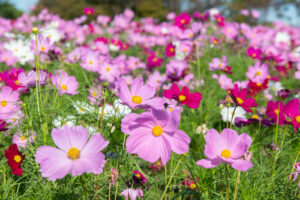
The first thing that catches the eye at Nabana no Sato in autumn is the cosmos blooming across Hanahiroba, the park’s expansive flower field. Covering about 43,000 square meters, the field is filled with around 1.5 million cosmos flowers when they are in bloom.
Cosmos, with pink and white flowers swaying in the breeze, is one of the flowers that evokes autumn in Japan. At Nabana no Sato, visitors can enjoy this seasonal scene on a large scale. The charm lies in both perspectives: seeing the delicate expression of the flowers up close, and looking out over a wide field where the colors seem to continue into the distance.
The view changes little by little depending on where you walk. Up close, you begin to notice the color and gentle sway of each individual bloom. From farther away, Hanahiroba appears as one broad seasonal landscape. For those who enjoy photography, the field also offers different impressions depending on the brightness of the sky and the angle of the light.
Cosmos begin to suggest the arrival of autumn earlier than the peak season for fall leaves. If you are visiting from late September onward, Nabana no Sato is well worth considering as a place to add seasonal flower scenery to your trip.
Giant dahlias worth seeing up close
While cosmos create a soft autumn scene across the whole field, dahlias leave a strong impression through the presence of each individual flower.
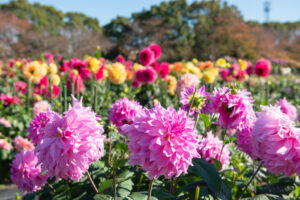
Nabana no Sato grows many large-flowered dahlias, including super-giant blooms that can reach around 30 to 40 cm in diameter.
The appeal of dahlias is not only their size. They come in a wide range of colors, including red, pink, yellow, orange, and white, and the shape and layering of the petals vary from one variety to another. Some are round and neatly formed, some have layers of fine petals spreading outward, and others feel distinctive enough to go beyond the usual image of a flower.
Cosmos create an autumnal sense of openness across Hanahiroba, while dahlias become more striking when you come closer and pay attention to the differences between varieties. The layers of petals, gradations of color, and scale of each bloom give even a single flower a strong presence.
As the season progresses, the lightness of the cosmos landscape is joined by the vividness of the dahlias. Even within the same flower field, the impression changes depending on where and when you look. That change is part of the interest of this season at Nabana no Sato.
Autumn roses in Begonia Garden
After walking through the wide flower field, the rose garden inside Begonia Garden is also worth visiting. The garden covers about 7,590 square meters and features more than 5,000 rose plants from around 900 varieties.
Here, visitors can see many kinds of roses, including hybrid tea roses, known for large individual blooms, and floribunda roses, which produce medium-sized flowers in clusters. Climbing roses, English roses, old roses, and other types also add variety. Even if you are not especially familiar with roses, walking through the garden while looking at differences in color, form, and blooming style makes each variety’s character easier to notice.
The rose garden includes arches, gazebos, stone decorations, and other features designed to show climbing roses in three-dimensional forms. A small stream also runs through the center, creating a calm garden atmosphere that differs from the open feeling of Hanahiroba.
Autumn roses usually reach their best season from around mid-October to early November. Visiting the rose garden after seeing cosmos and dahlias makes it clear how different autumn flowers can create very different kinds of spaces. Hanahiroba is about openness and scale, while the rose garden invites visitors to enjoy the arrangement of flowers and the atmosphere of the garden itself. The contrast between the two is one of the pleasures of walking through Nabana no Sato in autumn.
Feeling autumn deepen through changing flowers
In autumn, Nabana no Sato is colored by cosmos, dahlias, and autumn roses, each reaching its main season at slightly different times. Because of this sequence, visitors can feel autumn not as a single fixed season, but as something that gradually unfolds.
In the earlier part of the season, the lightness of the cosmos leaves a strong impression. As autumn deepens, the colors of dahlias and roses add richness to the park. Japanese autumn is not expressed only through red and gold leaves. Seasonal change can also be felt in the colors of flowers, the way they bloom, and the atmosphere of a garden.
As you walk through Nabana no Sato, you can sense autumn beginning and gradually deepening through the flowers.
At the same time, the best time to see the flowers can vary depending on weather and temperature. The same scenery is not guaranteed every day.
That is why it can be more rewarding to visit with an open mind and enjoy the particular expression of the flowers on that day.

Light-up displays offer a different evening atmosphere
Nabana no Sato is also memorable after dark. In 2026, the Dahlia and Cosmos Festival is planned from around September 20 to mid-October, and during that period, Hanahiroba is scheduled to be lit up from sunset until closing.
During the day, the colors of cosmos and dahlias can be enjoyed under the brightness of the sky. After sunset, the illuminated flower field takes on a different atmosphere. The colors of the flowers and the appearance of the paths change from daytime, creating a quiet night view of seasonal flowers.
From October 17, 2026 to May 31 of the following year, a major light event is also planned across the park, including water illuminations and light tunnels. Depending on the timing of your visit, you can encounter different night scenes: the Hanahiroba light-up during the autumn flower season, or the full-scale illumination event from mid-October onward.
An autumn trip in Mie that goes beyond the flower fields
Nabana no Sato is not a place where the visit ends once you have seen the flowers. Inside the park, there are restaurants, cafés, and shops, so visitors can spend time over a meal or a break after walking through the flower fields and gardens.
Its location in Kuwana City, Mie, also makes it easy to include in a trip through the Tokai region. It is possible to travel from the Nagoya area, or to combine the visit with other destinations in Mie. Adding time among flowers to a trip focused on cities or historic streets gives the journey a different rhythm.
Nearby, visitors can also spend time at other facilities within Nagashima Resort, including Nagashima Spa Land and Mitsui Outlet Park Jazz Dream Nagashima. By traveling farther into Mie, a trip that begins with flowers can expand into other parts of the region.
Nabana no Sato works both as a main destination where you can spend time at a relaxed pace, and as a stop within a broader itinerary. Its flexibility is part of its appeal: flowers can become the reason to widen the range of a trip through the Tokai region.

Discover an autumn in Japan beyond fall foliage
When people think of autumn in Japan, many imagine fall foliage, temples, and shrines. At Nabana no Sato, however, visitors can encounter another version of the season through flowers.
There is the openness created by around 1.5 million cosmos, the strong presence of dahlias with their wide range of forms, including super-giant blooms, and the autumn roses seen while walking through a garden. Depending on when you visit, the evening light-up of Hanahiroba adds another layer to the experience. Each type of flower has its own way of being seen, and the impression of the scenery also changes with the time of day.
When considering what to do in the Tokai region, Nabana no Sato offers a clear way to add seasonal color to a trip. For those who enjoy flowers, photography, or the changing seasons of Japan, autumn at Nabana no Sato is easy to understand and easy to remember.
Japan’s autumn is not only something to wait for in the form of fall leaves. By walking among cosmos, dahlias, and roses, visitors can experience the colors that mark the beginning of the season and its gradual deepening.
 Nagoya Travel Guide