
News
2026.10.1Blog
Autumn in Iga: Discover 400 Years of Tradition at the Ueno Tenjin Festival, with Oni Processions and Danjiri Floats
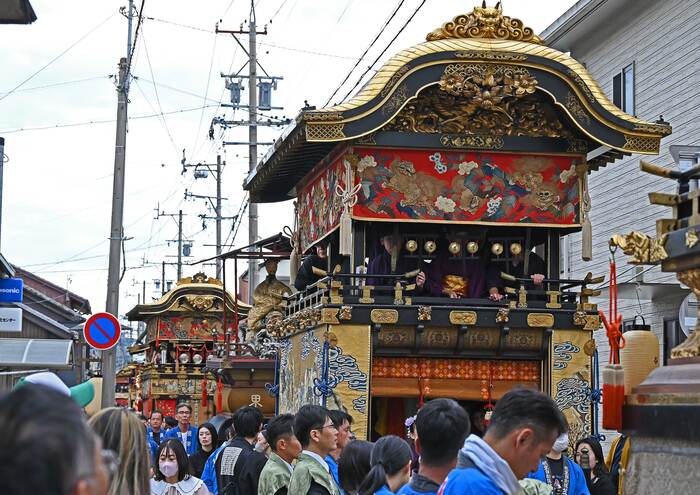
Iga City in Mie is widely known as the home of the ninja. But if you visit Iga in autumn, there is another tradition worth discovering: the Ueno Tenjin Festival, which has been passed down through the castle town for more than 400 years.
The festival unfolds through the historic streets of Iga Ueno. Following the mikoshi (portable shrines), a procession of well over a hundred oni (Japanese ogres) and nine magnificent danjiri (festival floats) moves through the town, accompanied by the sounds of conch shells, drums, and traditional festival music. Rather than watching a show at a single venue, you experience a festival in which the streets where people live become the stage.
Highlights include the distinctive oni procession, a rare sight even in Japan; nine danjiri, each decorated in its own style; and the changing atmosphere of the castle town from day to night. You do not need to know the history or meaning of the festival beforehand. The sights and sounds alone can draw you in, and from there, you can begin to discover the depth of the culture that has been handed down in Iga.
In 2026, the festival reaches a special milestone: 10 years since the Ueno Tenjin Festival’s Danjiri event was inscribed on UNESCO’s Intangible Cultural Heritage list. From Fri, October 23 to Sun, October 25, the streets of Iga Ueno take on an atmosphere found only during these three days.
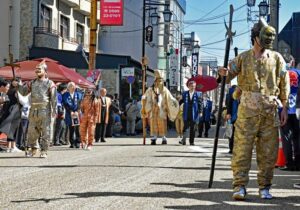
Well over a hundred oni move through the castle town
One of the most memorable sights of the Ueno Tenjin Festival appears during the Shinko Festival, the main event held on the final day: the oni procession. Seeing one masked and costumed figure after another is striking enough at first glance, but learning more about the procession reveals that it is far more than simply a parade of oni.
The procession consists of two groups: the En no Gyoja Procession, maintained by Ueno Aioicho, Ueno Konyamachi, and Ueno Sannomachi, and the Chinzei Hachiro Tametomo Procession, maintained by Ueno Tokuicho.
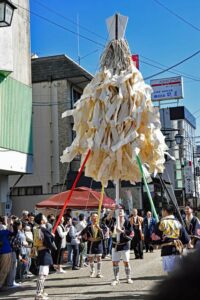
To the sound of conch shells and drums come a large sacred wand, fearsome oni, figures wearing a variety of masks, yamabushi (mountain ascetics), and others. Some of the oni stride proudly through the streets, while the hyorotsuki oni stagger and sway across the road, giving the procession a distinctive sense of humor as well as a fearsome appearance.
One of its central figures is En no Gyoja, a mountain ascetic from the Nara period who is regarded as the founder of Shugendo, a Japanese tradition of mountain ascetic practice. At the Ueno Tenjin Festival, he is also introduced as a figure sometimes described as an ancestor of the Iga-ryu ninja. In Iga, a place so closely associated with ninja history, finding this unexpected connection within the festival adds another layer of interest.
The other group, the Chinzei Hachiro Tametomo Procession, depicts Minamoto no Tametomo, a 12th-century warrior famed for his skill with a powerful bow, returning in triumph after defeating oni. These two processions, with very different origins, come together to form a group of well over a hundred figures moving through the castle town.
The oni procession has also carried prayers for protection from epidemics and for abundant harvests, while clearing the way for the sacred procession. Looking beyond the unusual costumes to the wishes and beliefs behind them can change the way you see the festival.
Nine magnificent danjiri, each with a story of its own
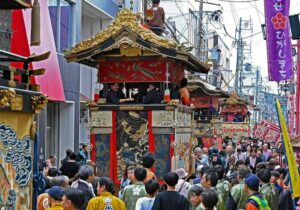
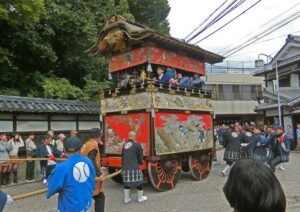
Following the oni procession come nine danjiri. Nine neighborhoods along Honmachi-suji and Ninomachi-suji each preserve one float, and during the festival they make their way through the castle town in their elaborate finery.
Each danjiri has its own decorations, including embroidered and woven curtains, carvings, and ornamental metal fittings. Step closer and you can begin to notice the craftsmanship that has been carefully preserved over many years.
Once the danjiri start moving, however, their character changes. They are no longer simply works of craftsmanship to admire up close, but become part of the festival in motion. Traditional festival music, centered on Gion-bayashi, fills the streets as groups of people pull the large floats through the town.
Watching how the danjiri are maneuvered along the streets of the old castle town is another highlight. Levers are used for small adjustments in direction, while at intersections a special mechanism beneath the float helps turn its large body. After first being drawn to the ornate decoration, you may find yourself noticing something else: the strength and skill required to move these huge floats by hand.That shift in perspective is part of what makes seeing the procession in person so rewarding.
Three days, three different sides of the festival
The 2026 Ueno Tenjin Festival takes place from Fri, October 23 to Sun, October 25. Rather than repeating the same program on all three days, the festival gradually builds toward the Shinko Festival on the final day.
On the first day, known as Yoi-yoi-yama, the nine danjiri are pulled out into their respective neighborhoods and displayed along streets including Honmachi-suji and Ninomachi-suji. This is a chance to see up close the floats that are normally kept in storehouses and take time to appreciate their decoration. As evening approaches, lanterns are lit and the sounds of festival music begin to drift through the streets.
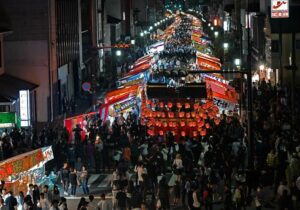
On the second day, the Ashizoroe no Gi takes place, with the oni procession and danjiri actually moving through the town. Then comes Yoiyama in the evening. The danjiri, illuminated by lanterns, travel through the darkened castle town and take on a very different appearance from during the day. Candlelight, festival music, and historic streets come together in a scene you can only encounter by staying into the evening.
The Shinko Festival on the final day is the climax. Led by the mikoshi procession, the oni procession and all nine danjiri follow, moving through the castle town from morning into the afternoon. Oni masks, embroidered curtains and metalwork on the floats, festival music, drums, conch shells, and the calls of the people taking part—all the individual elements seen over the previous days come together in one long procession through the streets.
Your experience will depend on which day you visit. If you want to examine the danjiri decorations up close, Yoi-yoi-yama is a good choice. If you want to see how the atmosphere changes between day and night, consider the second day. And if you want to experience the full scale of the festival, the Shinko Festival brings all its major elements together.
Each day reveals a different side of the Ueno Tenjin Festival.
When the town itself becomes the stage
The oni and danjiri are not the only things that make the Ueno Tenjin Festival memorable. The castle town of Iga Ueno around them is also an essential part of the experience.
The procession passes through streets such as Honmachi-suji, Ninomachi-suji, and Sannomachi-suji. The street layout of the Edo period can still be seen in Iga Ueno, and it is along these same streets that the mikoshi, oni, and danjiri make their way.
This is not a space created specially for an event. It is a town where people have continued to live for generations, and where the same festival has been layered onto everyday life again and again over the centuries.
The Ueno Tenjin Festival was revived in 1660, and the form that eventually developed into today’s oni procession and danjiri parade took shape gradually over the years that followed. A woodblock print from 1840 even depicts a procession similar to the one seen today.
So while watching the procession, remember to look beyond it from time to time at the buildings and streets around you. An oni emerging between historic buildings or an ornate danjiri turning into an old street has a sense of continuity that a purpose-built modern event venue cannot recreate.
A living tradition, 10 years after its UNESCO inscription
The cultural value of the Ueno Tenjin Festival lies in more than its long history. The festival is sustained not only by physical objects such as the danjiri and oni masks, but also by the people who pull the floats, perform the music, take part in the procession, and prepare the festival within their communities.
In 2016, the Ueno Tenjin Festival’s Danjiri event was included, together with festival traditions from other parts of Japan, in the UNESCO Intangible Cultural Heritage element Yama, Hoko, Yatai, float festivals in Japan.
Intangible cultural heritage is about more than preserving objects. It also includes the knowledge, skills, and practices that communities continue to pass from one generation to the next.
The year 2026 marks 10 years since that initial UNESCO inscription. As you enjoy the spectacular procession, it is worth remembering the generations of people behind it and the time they have spent keeping the tradition alive.
This is not a scene from the past recreated for visitors. It is a living local festival that still takes place in the community today. Seeing that culture in the streets, on the day it is actually practiced, is one of the most meaningful reasons to visit the Ueno Tenjin Festival.
Discover Iga’s history beyond the ninja
Iga is widely known for its connections with ninja history. Even if ninja culture is what first brought the area to your attention, the Ueno Tenjin Festival offers an opportunity to discover another side of Iga.
The history of the castle town, the rituals of Ueno Tenjin Shrine, danjiri handed down by individual neighborhoods, the oni procession, and festival music preserved by local communities all remain part of life here. As you walk through the Ueno Tenjin Festival, you begin to see a side of Iga’s culture that cannot be understood through the image of the ninja alone.
At the same time, there are also unexpected connections between the festival and ninja culture, such as the story of En no Gyoja in the oni procession. You might visit ninja-related sites before seeing the festival, or let the festival inspire you to explore more of Iga’s history afterward. Either way, looking at the same region from different angles can reveal how its different layers of culture connect.
Iga Ueno is about 90 minutes from Nagoya by direct highway bus. It can also be reached via the Kintetsu Osaka Line and JR Kansai Main Line, making the festival possible to include in an autumn trip through the Chubu and Kinki regions.
An autumn scene unique to Iga, with oni and danjiri in the streets
If this is your first time at the Ueno Tenjin Festival, the sight of the oni procession and magnificent danjiri may be what strikes you first. Then, as you walk through the castle town listening to festival music, drums, and conch shells, you begin to realize that each of these traditions has been passed down through a long history.
There is the daytime procession and Yoiyama after dark, when lanterns glow on the floats. There are imposing oni and nine danjiri decorated down to the finest detail. There are historic streets and the people who continue to support the festival within them.
The appeal of the Ueno Tenjin Festival does not lie in any one of these elements alone. It comes from seeing them overlap in the same town.
If you visit Iga, take the opportunity to look beyond its famous ninja heritage and discover another part of the region’s history. A festival passed down for more than 400 years is still moving through the streets of the castle town today, rather than sitting behind glass in a museum.
For three days in autumn, the Ueno Tenjin Festival offers a memorable way to encounter Japan’s living local culture in greater depth.
 Nagoya Travel Guide